
Hamid Mollazadeh
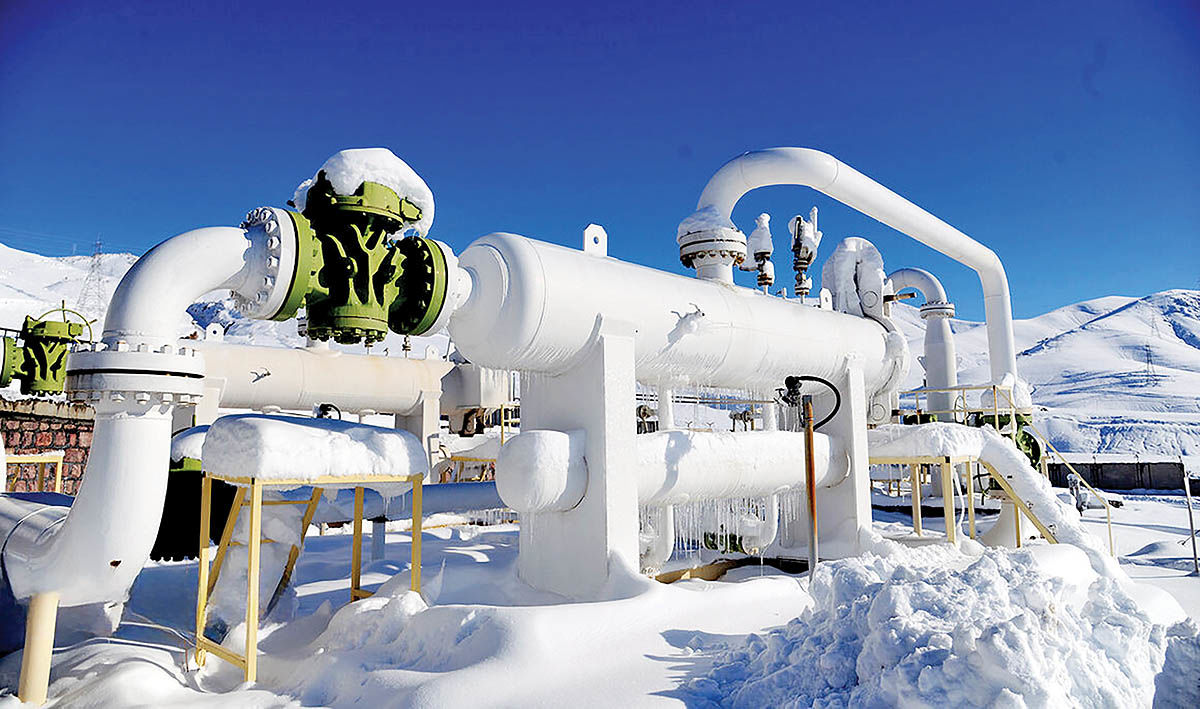
As a new wave of severe cold sweeps across Iran, the country’s natural gas network has entered a state of full operational readiness, underscoring once again the structural tension between soaring domestic demand and limited flexibility on the supply side.
Senior officials at the National Iranian Gas Company (NIGC) say the system remains stable for now, but warn that the coming days will be “decisive” as temperatures drop below zero across much of the country, including regions that rarely experience prolonged cold spells.
According to official data, Iran’s daily gas production has reached 882 million cubic meters, a record level that reflects maximum operational capacity under winter conditions. Yet this impressive figure masks a growing imbalance. In the first days of the current week alone, around 700 million cubic meters per day were consumed by the household, commercial and small industrial sectors, while roughly 170 million cubic meters was allocated to power plants. This leaves only a marginal volume available for large industries such as steel, cement and petrochemicals, effectively pushing them to the edge of gas rationing.
Speaking on the state of the network, the CEO of the NIGC stressed that while gas flow remains stable, the persistence of extreme cold requires uninterrupted operational alertness.
“From today (Wednesday) until weather conditions normalize, we must remain on full standby,” he said, noting that the incoming cold air mass from western and northwestern regions is expected to last at least until early February and is more intense than in previous years. Unusually, even southern provinces are now feeling the impact of the cold wave.
Pressure on Demand Side
The pressure is most visible on the demand side. The NIGC has warned that more than 80 percent of the country’s sweet gas production is expected to be consumed by the residential, commercial and small industrial sectors in the coming days. Daily consumption in these segments is projected to exceed 700 million cubic meters, a level that significantly constrains supply options for other sectors. With cold weather forecast to persist, officials are urging consumers to play a direct role in safeguarding network stability.
Public appeals have focused on relatively simple measures: setting indoor temperatures at around 20 degrees Celsius, adjusting boiler and package unit temperatures between 50 and 60 degrees, avoiding heating in unoccupied buildings and using season-appropriate clothing indoors.
While such recommendations may appear modest, gas officials emphasize that collective compliance can make the difference between system stability and forced disruptions.
Long-Lived Cold Spell
At the operational level, the Oil Ministry has instructed all provincial gas companies to strictly and immediately implement decisions issued by the central dispatching control room.
Saeed Tavakoli, the head of NIGC has highlighted this cold spell is not a short-lived event. “This is not a one- or two-day situation,” he said. “Forecasts indicate that the cold will be heavy and persistent, which makes production stability and coordinated operations absolutely vital.”
Supervision and enforcement have also been stepped up. Authorities have announced tighter inspections, particularly targeting government buildings and garden villas, which are often associated with excessive or inefficient gas use during winter months. Alongside these measures, officials say cultural and awareness campaigns will be intensified to reinforce the message of energy responsibility.
On the supply side, South Pars gas field in Asalouyeh, Bushehr Province, remains the backbone of Iran’s gas system, accounting for around 80 percent of total production. However, even this giant field is no longer sufficient to fully cover domestic demand during peak winter consumption.
Gholamabbas Hosseini, the CEO of the South Pars Gas Complex, said its refineries are currently injecting about 600 million cubic meters of gas per day into the national grid. Since the beginning of the Iranian year, more than 163 billion cubic meters of gas have been processed and delivered from South Pars alone.
Squeezed Availability
Despite record production, the dominance of household consumption has dramatically squeezed gas availability for large industries. According to NIGC figures, the combination of roughly 700 million cubic meters consumed daily by households and small users, plus about 170 million cubic meters delivered to power plants over the last few days, brings total usage to nearly 870 million cubic meters per day. This leaves an estimated 12 million cubic meters for all major industries combined — a negligible share for sectors such as steel, cement and petrochemicals that form the backbone of Iran’s non-oil economy.
In winter, policymakers tend to prioritize electricity generation over industrial gas supply, given its immediate social and economic importance.
As a result, power plants increasingly switch to liquid fuels such as diesel and mazut when gas deliveries are constrained, a shift that carries both environmental and logistical costs.
Industry executives warn that repeated gas cuts disrupt production chains, raise costs and weaken competitiveness, even as household consumption continues to absorb the lion’s share of available supply.