
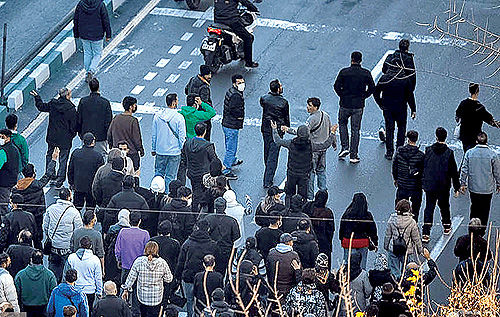
In recent days, protests have emerged in various parts of Iran, and it seems that at least part of the roots of these unrests is related to economic and livelihood issues.
Among the economic reasons for the emergence of social unrest, economists have pointed to indicators such as income inequality, poverty, inflation, and unemployment.
With the increase in economic inequality and the decline in people’s living conditions and the deepening of poverty in society, social unrest emerges, which ultimately leads to social and political instability. Although economic factors play a role in the formation of social unrest, these unrests have a direct impact on the economy.
In a study conducted by Yaldah Dadgar and Hasan Mahmoudvand cited by Donya-e-Eqtesad, the economic reasons for unrest and their role in the decline of the economic situation in society have been addressed.
Inequality leads to the formation of social and political unrest, and despite the resulting instability, it indirectly threatens property rights and reduces investment, which ultimately has a negative impact on economic growth.
The findings of this study suggest that to improve political and social stability and reduce unrest, countries must, on one hand, reduce inequality and, on the other hand, strengthen democratic institutions to protect property rights.
The current Iranian month has been marked by protests across Iran, involving a diverse range of participants. The first spark of these protests came from merchants and market traders and then spread to other groups.
Therefore, many consider the economic roots of the recent protests to be significant. Factors such as income inequality, the rise in the number of people below the poverty line, the increase in inflation and unemployment, and perhaps the most important factor, the lack of a clear horizon for the future situation are among the factors that have contributed to the intensification of protests.
Defective Cycle
However, the decline in economic conditions does not only cause unrest but the resulting instability itself becomes a factor in weakening the economy. As a result, a cycle is formed that starts with a bad economic situation and ultimately leads to a worsening of the same sector. Economic drivers are sidelined, infrastructure is damaged, and property rights, which are weakened, lead to a decrease in investment, resulting in negative economic growth rates.
Various economic studies have been conducted on the role of economic factors in social and political unrest. Dadgar and Mahmoudvand in a study titled “Investigating the Relationship Between Inequality and Social Unrest: Iran and Selected Countries” have examined the effect of inequality in the formation of social unrest.
Inequality can include income inequality, wealth inequality, opportunity inequality, gender inequality, inequality in education and health conditions, etc. In this study, 53 countries, including Iran, from two groups of developed (36 countries) and Middle East and North Africa (17 countries) have been studied. In this study, it is also mentioned that Iran has also experienced movements and unrest.
The Constitutional Movement was formed with the aim of establishing a parliament, forming parties, and social freedom. In the deposed Pahlavi government, the process of industrialization was initiated, and with the expansion of infrastructure, rural migration to cities, urbanization, and the formation of the working class and the middle class, social movements developed in the direction of economic goals.
After the 1979 Islamic Revolution, unrests in the direction of achieving social justice and freedom have emerged, including the protests in 2017, the strikes of truck drivers and sugar cane workers in 2018 and the protests over fuel price hike in 2019.
According to experts, these unrests have economic roots and most of the participants in them are young people under the age of 35. The age of the protesters can be matched with a type of unemployment called non-participating unemployment, which not only is unemployed but is also not engaged in education.
In the aforementioned study, various variables have been introduced to examine the relationship between inequality and unrest, and the effect of unrest on the status of property rights and investment is also studied. In the equations specified in this study, political and social stability is a function of income inequality, the misery index, which is itself made up of the inflation rate and unemployment, per capita income, average years of education, property rights, investment, and democracy.
In addition, property rights are a function of political and social stability, legal governance, and corruption control. On the other hand, property rights, real interest rate, capital stock, and per capita income are specified as explanatory variables of property rights.
Property rights are the ability of individuals and legal entities to maintain private ownership and are guaranteed by formal laws. Property rights determine how individuals can benefit or be harmed and who should pay for the actions of others.
Corruption occurs when individuals misuse their government positions for personal gain. The level of corruption affects the registration of contracts, the transfer of ownership, and the public’s confidence in the proper enforcement of property rights.
According to the results of this study, there is a negative correlation between income inequality and political stability, and this negative correlation is observed in both groups of developed countries and Middle East and North Africa. This means that with the increase in income inequality, political stability decreases.
On the other hand, the results indicate that there is a positive correlation between democracy and political stability. This means that with the strengthening of democratic institutions, political stability increases. In addition, a positive two-way relationship between political stability and property rights is another result of this study.
The more instability increases, the less economic agents’ confidence in the protection of private ownership. In addition to this issue, a positive correlation between the strengthening of property rights and the increase in investment is observed in developed countries. This is while this relationship is slightly negative for Middle East and North African countries.
Lessons for Policymakers
This study points out that countries that do not experience political freedom along with economic freedom may experience instability. In addition, property rights mean the opportunity for investment and, as a result, the creation of employment. On the other hand, improving property rights and increasing the security of individuals’ property reduces tension and unrest.
Ultimately, the policy recommendation of the study points out that income inequality leads to an increase in unrest both directly and indirectly; in fact, with political instability, property rights are threatened and investment decreases. Therefore, policymakers should include reducing inequality in their agenda with appropriate policies.
According to other findings of this study, two variables, inflation and unemployment, can also contribute to inequality and instability, which highlights the need for policymakers to pay attention to these economic variables.
Democracy is another indicator discussed in this study and can lead to an improvement in satisfaction and a reduction in unrest. Property rights reflect the institutional quality that includes the rule of law, political stability, and the fight against corruption and has a positive effect on investment and economic growth.
Ultimately, this study recommends that by strengthening factors that reduce unrest, policymakers help strengthen property rights and, as a result, economic growth.