
Hamid Mollazadeh
The global oil market opened 2026 with a paradox that would have seemed unthinkable a decade ago. Despite a dramatic escalation in geopolitical risk—marked by the US military strike on Venezuela, the detention of President Nicolas Maduro and Washington’s declaration that it was effectively taking control of the country—oil prices moved lower, not higher.
Brent crude fell to around $60 a barrel on January 5, defying the traditional logic that ties political upheaval in oil-producing states to price spikes. This muted reaction is not just a story about Venezuela’s diminished role in global energy. More importantly, it carries direct implications for Iran’s oil market, particularly its exports and pricing power under sanctions.
At first glance, the lack of a price rally appears counterintuitive. Venezuela sits on the world’s largest proven crude reserves and any disruption there would once have sent shockwaves through the market.
Today, however, the numbers tell a very different story. Global oil consumption stands at roughly 103 million barrels per day, while Venezuela’s production and exports remain below one million barrels per day—well under 1% of global supply.
In practical terms, Venezuela has become almost irrelevant to the balance of supply and demand. Its oil sector, hollowed out by years of mismanagement, sanctions and decaying infrastructure, had already been sidelined long before US missiles entered the equation.
This structural reality explains why traders largely ignored the headlines and focused instead on fundamentals. The oil market in 2025 and early 2026 has been characterized by ample supply, driven by resilient US shale output, steady production from non-OPEC producers, and OPEC+’s decision to keep output levels unchanged in the first quarter of the year. In such an environment, even severe political shocks struggle to generate a sustained “geopolitical premium.”
Critical Signal for Iran
For Iran, this is a critical signal: the market is no longer easily rattled, and price upside driven purely by political tension is increasingly hard to achieve.
Iran currently exports an estimated 1.2 million barrels per day, depending on market conditions and enforcement intensity, with most of that—roughly 1 million barrels per day—effectively anchoring its position in the Asian market, particularly China.
Unlike Venezuela, Iran’s exports are large enough to matter at the margin, but the broader market context severely limits Tehran’s leverage. When Brent struggles to hold above $60 despite military action against an OPEC member, it becomes clear that Iran cannot rely on regional instability alone to lift prices or improve its revenue outlook.
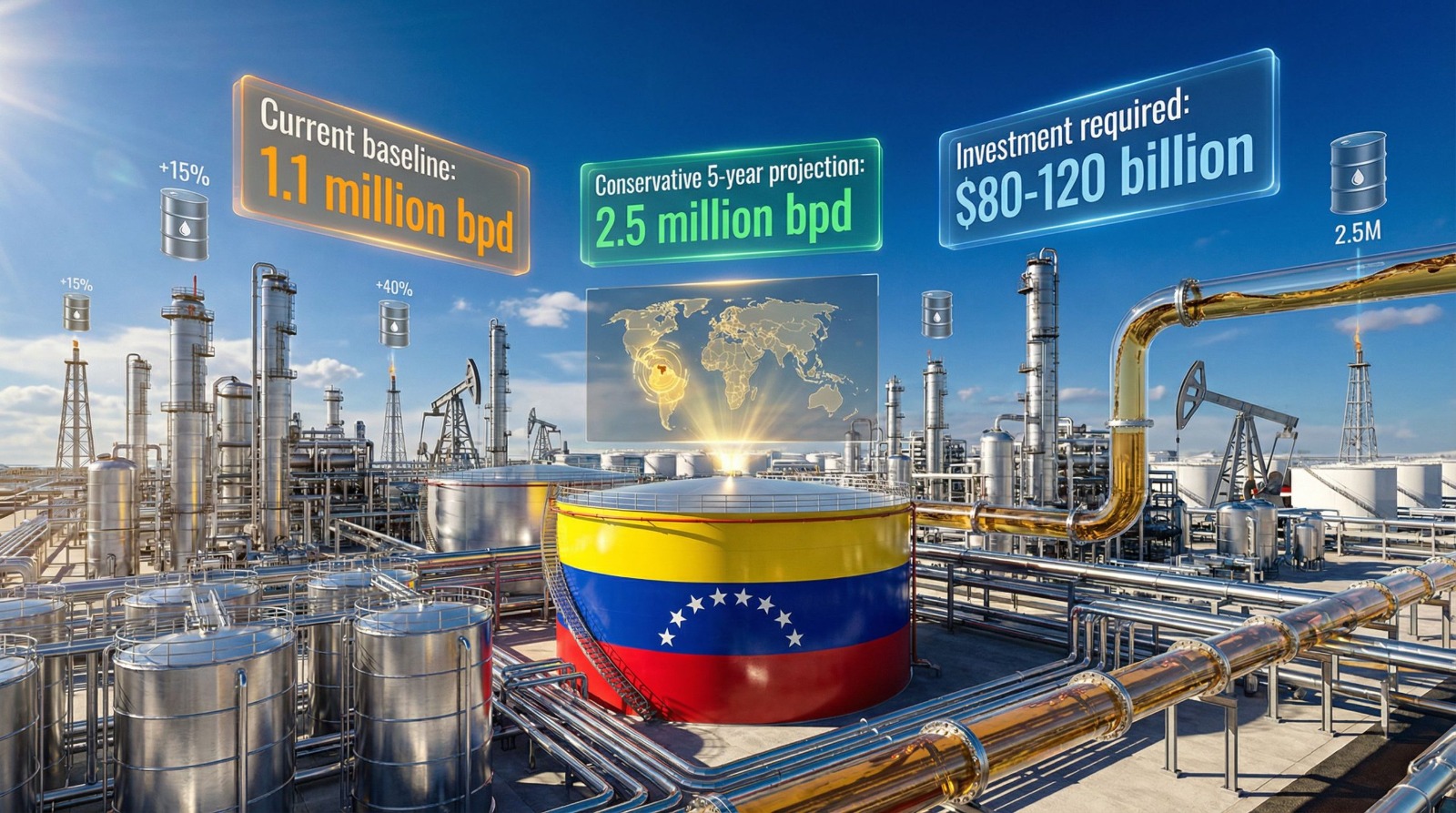
The Venezuelan episode also offers a cautionary parallel for Iran in another respect: the long-term consequences of isolation. Analysts broadly agree that even under a more cooperative political scenario, Venezuela’s oil output could only rise by a few hundred thousand barrels per day by the end of 2026, and only with significant foreign investment. Any meaningful recovery would take years.
For Iran, whose production capacity is far larger and infrastructure comparatively more intact, the lesson is stark. Prolonged sanctions do not just constrain exports; they gradually erode a country’s relevance in global energy markets, making geopolitical shocks less effective as pricing tools.
US policy signals reinforce this point. Washington has reportedly encouraged American oil companies to consider investing in Venezuela’s oil sector if they want to recover assets expropriated decades ago. The message to the market is not one of permanent supply loss, but of potential future barrels returning under a new political arrangement.
This forward-looking supply narrative has weighed on prices—and it matters for Iran. Any perception that sanctioned producers might re-enter the market over the medium term acts as a ceiling on prices, limiting Iran’s ability to benefit from short-term disruptions elsewhere.
Facing Geopolitical Pressures
At the same time, Iran faces its own geopolitical pressures. Recent US rhetoric has included renewed threats of intervention related to internal unrest, adding Iran to a broader landscape of political risk. Yet the Venezuela case suggests that unless such tensions translate into a clear and sizable reduction in physical supply, the market response will remain subdued.
In a world of surplus capacity and cautious demand growth—particularly amid concerns over China’s economic momentum—even Iran-related risks may struggle to move prices decisively.
For Iranian oil exporters, the implications are sobering. With prices under pressure and geopolitical premiums fading, maintaining export volumes becomes more important than ever. Discounting strategies, flexible shipping arrangements and deepening ties with key buyers like China are likely to remain central to Iran’s oil policy.
However, lower global prices directly squeeze revenues, especially when exports are already sold at a discount due to sanctions. The Venezuela shock—or lack thereof—underscores that Iran is operating in a buyer’s market, not a seller’s one.
Ultimately, the market’s indifference to Venezuela is a reminder that oil in 2026 is governed less by dramatic political events and more by cold arithmetic.
For Iran, the message is clear: relevance in the global oil market is measured not by reserves or rhetoric, but by sustained production, reliable exports and integration into the supply chain. In a world where even war does not guarantee higher prices, Iran’s oil strategy must adapt to a reality in which fundamentals—not fear—set the tone.